An ad creative brief should let a designer start without inventing the audience, offer, or delivery list. Copy the example below, replace its fictional campaign details, and link the actual copy, assets, and placement requirements. Leave unresolved facts visible.
Campaign: Ledger Switch, a fictional bookkeeping-app campaign.
Viewer: Independent consultants who keep invoice records in spreadsheets and have never used the app.
Job: Explain that the app can import their existing records; send interested viewers to the import instructions.
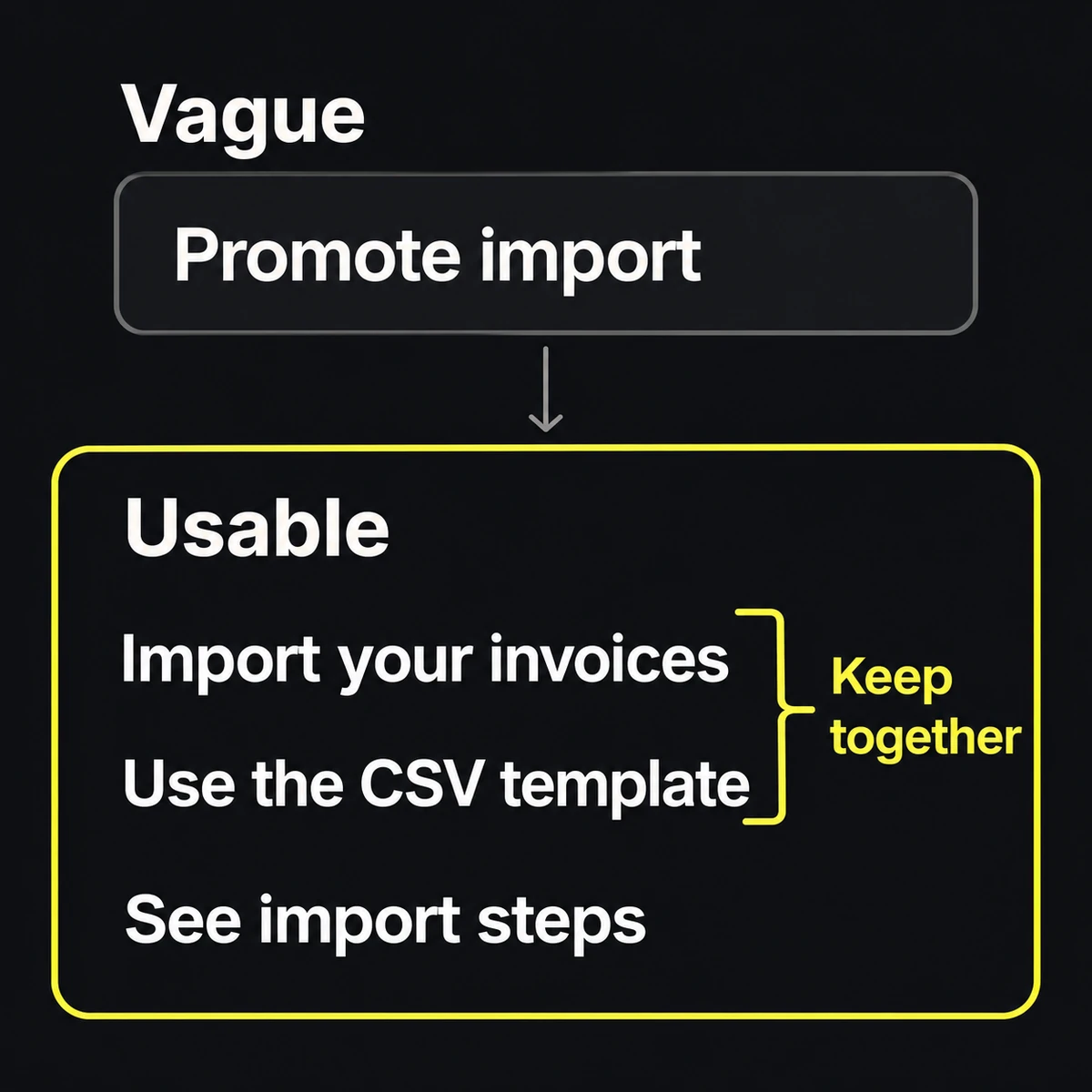
Message: Product identification: “Bookkeeping for independent consultants.” Headline: “Bring your invoices with you.” Supporting copy: “Import invoice records from a CSV file.” Required qualification: “Use the supplied CSV template.” These are example claims; replace them with verified product wording.
CTA and destination: “See import steps”; link to the live import guide.
Outputs: One square feed image and one vertical story image, in English. The media buyer supplies exact dimensions and accepted file types.
Sources: Link the approved logo, current import-screen capture, copy revision, and media plan. Keep the CSV qualification beside the import claim.
Decisions: Product lead confirms the import claim; design lead approves the layouts; media buyer accepts the exported files.
Open input: Current import-screen capture — product lead, due before layout review. A labeled placeholder is allowed in the concept draft, never in delivery.
Delivery: Approved exports, editable source, and file-to-placement list in the campaign delivery folder; enter an actual due date and time zone.
Define the viewer and the concrete action
Describe what the viewer already knows and the problem they are trying to solve. “Small business owners” leaves both unanswered. In the example, the spreadsheet habit explains the import message; unfamiliarity with the app means the ad must also identify it as bookkeeping software.
Name the action and destination together. If the goal is recognition rather than a click, state what the viewer should remember, such as the product name and the job it performs. Do not invent a trial or discount merely to give the brief a CTA.
Establish message hierarchy and non-negotiable claims
Give the designer an ordered copy list: product identification, main message, supporting detail, action, and required qualification. Link exact approved wording rather than asking the designer to infer product facts from a sales deck.
Mark which elements can be removed or shortened. In the example, an extra feature badge could go; the CSV requirement must survive. If the smallest placement cannot carry the claim and its qualification legibly, commission a simpler message for that placement.
Name placement families and raw asset permissions
List each placement, locale, output type, and quantity. Link the media buyer's delivery specifications and overlay references. “Square and vertical” is enough to discuss a concept; exact output dimensions are needed before final composition and export.
For each supplied visual, link the usable source and note permitted changes: crop, background removal, recoloring, or none. State whether a product screen may be cropped. A tightly cropped horizontal photo may need an alternate source for the vertical version; flag that before committing to a layout. The campaign asset checklist covers the file inspection.
Resolve open fields with owners and due dates
For each missing input, write the owner, due date, and work it blocks. An absent screenshot may allow a labeled concept placeholder. An unconfirmed offer blocks any layout whose hierarchy depends on that offer. The brief owner decides whether to start the unaffected work or move the production date.
Set review scope limits and delivery requirements
Name the people who decide copy, design, and delivery, plus the dates they must respond. A new audience or offer changes the brief; correcting an export to match approved copy is a revision.
Before sending the brief, ask the designer to name the files they will deliver, the message each must carry, and the missing inputs that could stop them. Compare that answer with your output list. Resolve discrepancies before production, then use the creative handoff checklist to define the receiving team's final check.